Patients in our Frisco office ask me this question often: “Can I have 20/20 vision and still have glaucoma?” The answer surprises most of them. Yes.
Glaucoma earned the nickname “the silent thief of sight” for a reason. Most people assume they’d know if they had it. They picture blurry vision, an aching eye, or some sign that something’s off. But the most common form of glaucoma stays quiet until the disease is well advanced.
That silence explains a sobering number. Half of people with glaucoma don’t know they have it, according to the Centers for Disease Control and Prevention (CDC).
What Are the Symptoms of Glaucoma?
 In its early stages, glaucoma usually causes no symptoms at all. No pain. No blur. No redness. When symptoms do show up, they typically start as a slow loss of side (peripheral) vision, followed by blind spots. Left untreated, glaucoma can eventually cause blindness.
The early warning signs of glaucoma are ones only your eye doctor can spot:
- A change in the shape or appearance of your optic nerve head
- Eye pressure (intraocular pressure, or IOP) that climbs from one visit to the next
- A visual field test that shows new gaps in your side vision over time
The Exception: Angle-Closure Glaucoma
One less common type breaks that pattern. In acute angle-closure glaucoma, eye pressure spikes fast, and the symptoms hit hard: intense eye pain, nausea, a red eye, and blurry vision. The National Eye Institute advises anyone with these symptoms to see a doctor or go to an emergency room right away.
What Causes High Eye Pressure?
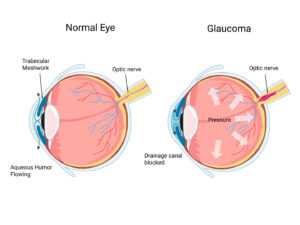
Your eye constantly produces a clear fluid called aqueous humor, and a matching amount drains out. High eye pressure develops when the eye makes too much fluid or its drainage system doesn’t let enough out. Doctors call this ocular hypertension.
High eye pressure alone doesn’t mean you have glaucoma or that you’ll develop it. It does, however, increase your risk, and it’s one of the main reasons an eye doctor may label you a “glaucoma suspect” and keep a closer watch.
Why Can’t Eye Pressure Alone Diagnose Glaucoma?
In the early 2000s and 2010s, eye pressure and visual field testing were the two main tools for monitoring a “glaucoma suspect.” Since then, we’ve learned that IOP readings vary a lot from person to person, partly because corneas vary in thickness.
The Glaucoma Research Foundation explains that a thin cornea can produce an artificially low pressure reading, while a thick cornea can read higher than the true pressure. A “normal” number can hide real risk, and a high number can overstate it.
For that reason, we now put less weight on IOP alone. A glaucoma diagnosis comes from seeing changes in the optic nerve head or watching a person’s visual field worsen over time.
IOP still matters, though, and here’s what I always remind my patients: You can have exceptionally high eye pressure and feel no pain and notice no blurred vision. Your eyes won’t warn you. An exam will.
How Do Eye Doctors Test for Glaucoma?
 A routine comprehensive eye exam can flag warning signs, like rising eye pressure or a change in the optic nerve. A dedicated glaucoma eye exam from Avant-Garde Optometry adds specialized testing, including:
- Eye pressure (IOP) checks with the Topcon CT-80
- Optomap imaging of the retina and optic nerve, usually without dilating drops, to spot structural changes before vision loss
- Visual field testing, starting with a baseline map of your side vision and repeated over time
- Gonioscopy, a quick lens exam of the eye’s drainage angle that tells open-angle glaucoma apart from angle-closure glaucoma
For patients flagged as “glaucoma suspects,” here’s how we typically follow up:
| Glaucoma risk level | Tests | How often |
|---|---|---|
| Low-risk glaucoma suspect | Visual field test and fundus photos of the optic nerve | Once a year |
| High-risk glaucoma suspect | Visual field test, watching for changes | Twice a year |
Who Should Get Checked for Glaucoma, and How Often?
Age matters most. The Glaucoma Research Foundation lists being 60 or older as a key risk factor, along with family history, and risk keeps rising with age. Here’s what we recommend:
- Age 60 and up: Get fundus photos and an eye pressure check.
- Glaucoma in your family: Schedule a routine eye exam once a year.
- A relative diagnosed young, or who lost vision to glaucoma: Add a visual field test every year.
Note: Glaucoma isn’t the only condition an eye exam can catch before you feel anything. Diabetes often shows up in the retina first, too.
Can Glaucoma Be Treated?
Glaucoma can’t be cured, but it can be controlled. Common treatments help lower eye pressure to prevent further damage to the optic nerve:
- Prescription eye drops that lower IOP
- Selective laser trabeculoplasty (SLT), a laser treatment that helps fluid drain out of the eye
- Peripheral iridotomy (PI), a laser procedure that creates a tiny opening in the iris to improve fluid flow
None of these drops or procedures is painful; however, sticking with treatment takes more effort.
In my experience, the main reason glaucoma gets worse is simple: patients get tired. Tired of daily drops, tired of repeat visual field tests.
In a 2019 study published in the Journal of Ocular Pharmacology and Therapeutics, about one-third of glaucoma patients reported missing their eye drops often enough to undermine treatment. It’s hard to stay committed to treating a disease when you can’t see any benefit.
If your drops feel pointless, remember what they protect: the vision you still have. And if side effects or a busy schedule make them hard to keep up with, tell us. We’d much rather adjust your plan than see you stop.
Book a Glaucoma Check at Avant-Garde Optometry in Frisco
A comprehensive eye exam checks your eye pressure and optic nerve health in a single visit. Schedule yours at our Frisco office.
If you’re already a glaucoma suspect or glaucoma runs in your family, ask about a dedicated glaucoma eye exam.
Frequently Asked Questions About Glaucoma
What eye pressure is considered high?
According to Cleveland Clinic, eye pressure above 21 mmHg at two or more visits may point to ocular hypertension.
Does high eye pressure cause headaches or eye pain?
Usually not. Angle-closure glaucoma can be the exception. An acute attack can bring a headache and rainbow-colored halos around lights, while the slower-developing form can cause headaches or a brow ache.
What else raises my risk for glaucoma?
Beyond age and family history, the Glaucoma Research Foundation lists diabetes, high blood pressure, heart disease, long-term steroid use, past eye injuries, and thin corneas as risk factors. The National Eye Institute also considers African Americans over 40 and Hispanic/Latino adults over 60 at higher risk.
Is glaucoma hereditary?
It can run in families. The Glaucoma Research Foundation notes that the rate of glaucoma can be 10 times higher for people with a sibling who has the disease, and genetic studies suggest more than 50 percent of glaucoma cases have a hereditary link. If you’ve been diagnosed, encourage your relatives to schedule eye exams of their own.
Where is Avant-Garde Optometry located?
We’re at 9255 Dallas Pkwy, Ste 140, Frisco, TX 75033, and we see patients from Frisco and the surrounding North Dallas suburbs.